Knowing how to test water softener after installation Calgary homeowners can trust is important because a newly installed system should not be judged by feel alone. Soft water can feel different, but the real proof comes from testing hardness, checking the bypass valve, reviewing salt use, confirming regeneration, and watching how your fixtures, laundry, dishwasher, and shower glass respond over the first few days.
A water softener may be installed correctly and still take some time to show full results, especially on hot water lines. If your water heater was already full of hard water before installation, the hot water side may need time to cycle through before you feel the full difference.
Calgary homes deal with naturally hard water. Water Softener Calgary notes that Calgary water can range from 152–290 mg/L as CaCO₃, which is high enough to create scale, soap scum, cloudy dishes, dry skin, and buildup inside water-using appliances. Water Softener Calgary also explains that city water systems may combine softening, filtration, and optional reverse osmosis depending on the home’s needs.
That is why post-installation testing matters. You do not want to assume the unit is working because it is new. You want to confirm it with simple checks.
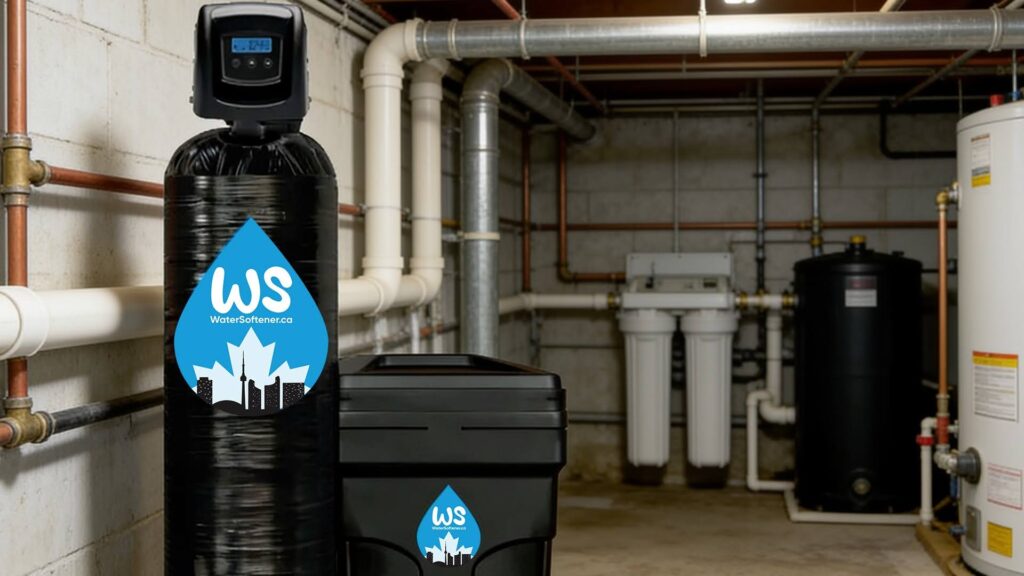
Start With a Hardness Test
The best way to test water softener after installation Calgary homeowners can rely on is to test hardness before and after the system.
A hardness test checks whether calcium and magnesium minerals are still present in the water. These are the main minerals responsible for hard water scale. Health Canada explains that hardness is mostly caused by calcium and magnesium, and ion exchange softeners are commonly used to reduce hardness in residential water.
You can test hardness using:
- Test strips
- Drop-count hardness test kits
- Professional water testing
- Installer-provided post-install test
- Lab testing for more detailed water concerns
A quick strip test can tell you whether hardness dropped after installation. A drop-count test can be more accurate because it gives a clearer hardness reading.
| Test Type | Best For | Limitation |
| Test strips | Quick homeowner check | Less precise than drop kits |
| Drop-count kit | More accurate hardness reading | Requires careful instructions |
| Installer test | Immediate post-install confirmation | Only shows result at that time |
| Lab test | Full water quality review | Slower and more detailed than basic hardness testing |
If the softener is working properly, the softened water reading should be much lower than the incoming hard water reading.
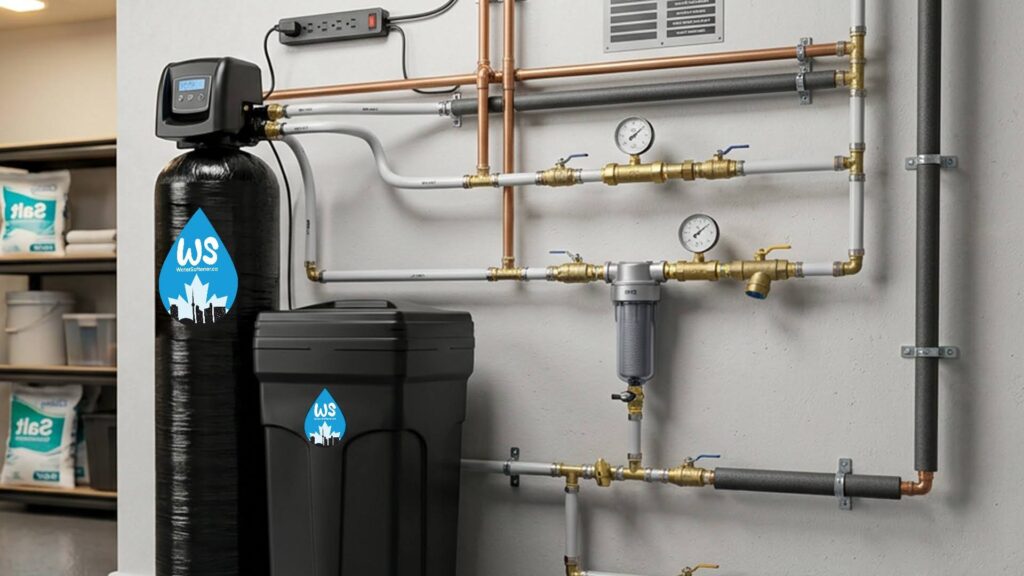
Test Cold Water First
Cold water is usually the best first place to test after installation. That is because cold water lines should receive softened water more quickly than hot water lines.
Choose a cold-water tap that is clearly after the softener. A laundry sink, bathroom sink, or utility sink may work well, depending on your plumbing layout. Avoid testing an outdoor tap unless you know it is softened. Outdoor taps are often bypassed because lawns and exterior cleaning do not need soft water.
When testing cold water:
- Let the tap run for a minute.
- Collect a fresh sample.
- Use a hardness test strip or drop-count kit.
- Compare it with the hard water reading.
- Record the result.
If the cold-water test still shows hard water, check the bypass valve first. The system may be installed but still partly or fully in bypass mode.
Give Hot Water More Time
Hot water may take longer to show results because the water heater stores water. If the tank was full of hard water before installation, that water has to be used and replaced with softened water.
This is why some homeowners think the softener is not working when the real issue is timing.
You may need to run several hot-water cycles through normal household use before hot water feels fully softened. This includes showers, laundry, dishwasher use, and regular sink use.
| Water Area | When You May Notice Results |
| Cold bathroom tap | Usually sooner |
| Laundry cold cycle | Usually sooner |
| Shower hot water | May take longer |
| Dishwasher | May take a few cycles |
| Water heater | Needs time to refill with softened water |
| Kitchen tap | Depends if it was softened or bypassed |
Do not judge the softener only by your first hot shower after installation. Test cold water first, then watch hot-water results over the next few days.
Check the Bypass Valve
The bypass valve controls whether water flows through the softener or around it. If the valve is in bypass mode, the home may still receive hard water even if the system is installed correctly.
This is one of the simplest but most important checks when you test water softener after installation Calgary homes.
Ask yourself:
- Is the bypass valve in service mode?
- Did the installer show you how it works?
- Is it fully open to the softener?
- Is it blocked by storage or hard to reach?
- Is there a separate bypass for filtration?
A bypass valve is useful during service, emergencies, or repairs. But after installation, it should normally be set so water flows through the softener.
If the water still tests hard, check this before assuming the equipment is defective.
Confirm the System Is Programmed Correctly
A water softener must be programmed based on water hardness, household size, capacity, and regeneration settings. If the hardness setting is wrong, the system may regenerate too late, too often, or not effectively enough.
The installer should program the control valve during setup, but homeowners should still know the basics.
Important settings may include:
| Setting | Why It Matters |
| Hardness level | Tells the system how much mineral content to treat |
| Regeneration time | Usually set for low-use hours |
| Capacity | Controls how much soft water is available between cycles |
| Salt dose | Affects softening strength and efficiency |
| Metered setting | Regenerates based on water use |
| Time setting | Regenerates on a fixed schedule |
If your water still feels hard after several days, the programming may need adjustment. This is especially possible if the hardness level was estimated instead of tested.
For municipal homes, review city water softener and filter options to understand how hardness, chlorine, and filtration may be handled together. For private wells, well water softener and filter systems may require more detailed testing because iron, manganese, sediment, or odour can affect performance.
Check the Salt Level
A salt-based water softener needs salt to regenerate. If the brine tank has no salt, the system cannot properly recharge the resin.
After installation, check:
- Is there salt in the brine tank?
- Is the salt level above the water level?
- Is the salt loose, not hardened?
- Is there a salt bridge?
- Is the brine line connected?
- Is the system using salt over time?
A newly installed system should not use a huge amount of salt immediately, but over time the salt level should gradually drop. If the salt level never changes, the system may not be regenerating or drawing brine correctly.
Do not fill the tank blindly to the top unless instructed. Keeping too much salt in the tank can sometimes make salt bridging harder to notice.
Watch for Regeneration
Regeneration is the cleaning cycle where the softener recharges the resin. During this cycle, the system draws brine, rinses the resin, and sends wastewater to the drain.
You may notice regeneration by:
- Sound from the control valve
- Water moving through the drain line
- A scheduled overnight cycle
- Display changes on the valve
- Temporary water flow sounds in the mechanical room
A metered system regenerates based on water use. A timed system regenerates on a fixed schedule. If no regeneration happens when expected, the system may need a programming check, power check, or service review.
Make sure the system is plugged in and the display is active. A modern water softener cannot regenerate correctly if it has lost power.
Check the Drain Line
A softener’s drain line should be secure, properly routed, and positioned safely. During regeneration, water moves through this line, so it should not jump, leak, or discharge in the wrong place.
Check the drain line for:
- Secure placement
- No kinks
- No visible leaks
- No movement during regeneration
- Proper drain connection
- No backup from the drain
- No standing water around the softener
If you see water near the unit after regeneration, call for service. A drain issue can cause mess, odour, or system performance problems.
Look at Fixture-Level Results
Hardness testing is the best proof, but daily results matter too. A properly working softener should gradually reduce the signs of hard water around the home.
Watch for changes in:
| Area | What Should Improve |
| Shower glass | Less white film and easier cleaning |
| Faucets | Less mineral crust around edges |
| Dishwasher | Fewer spots on glassware |
| Laundry | Softer fabric feel and better detergent performance |
| Soap lather | More lather with less soap |
| Skin and hair | Less dry, coated feeling for some users |
| Kettles and fixtures | Slower scale buildup |
Some old scale will not disappear instantly. Existing buildup on faucets, shower doors, and appliances may need cleaning first. The softener helps reduce new scale, but it does not magically remove every old deposit overnight.
Test Before and After Cleaning
A smart way to judge performance is to clean a few fixtures after installation and then watch how quickly scale returns.
Choose two or three visible areas:
- Shower glass
- Bathroom faucet
- Kitchen faucet
- Kettle
- Dishwasher glassware
- Laundry results
Clean them once after installation. Then check them after one week and again after two weeks. If the softener is working, new scale should form more slowly.
This practical check helps homeowners separate old hard-water buildup from new performance issues.
Check Water Pressure and Flow
A properly installed water softener should not make daily water use frustrating. If water pressure drops noticeably after installation, something may need adjustment.
Possible causes include:
- Undersized system
- Incorrect valve setup
- Partially closed bypass valve
- Clogged pre-filter
- Plumbing restriction
- Incorrect installation point
- Sediment issue
- Well-water equipment restriction
If pressure feels weak at multiple fixtures, call the installer. A flow issue should be checked early, especially in larger homes or homes with multiple bathrooms.
Know What Is Normal After Installation
Some things are normal after installation. Others are not.
| Normal | Not Normal |
| Hot water takes time to feel soft | Cold water still tests hard after setup |
| Slight change in water feel | Visible leak near fittings |
| Old scale remains until cleaned | Drain line moving or overflowing |
| Dishwasher improves after cycles | Salt level never changes over time |
| Soap lathers differently | Control valve shows error codes |
| Water heater needs time to cycle | Bypass valve stuck or unclear |
If something feels off, do not wait weeks. A quick post-install adjustment can prevent ongoing frustration.
When to Call for Service
Call for service if:
- Hardness test still shows hard water
- Water feels unchanged after several days
- Salt is not being used
- Brine tank is full of water
- System is stuck in regeneration
- Water pressure drops suddenly
- Drain line leaks or moves
- Valve display shows an error
- Scale returns quickly
- Iron staining appears
- You hear unusual sounds
- You cannot confirm bypass position
For Calgary homeowners, service is especially important if the system was installed to handle more than basic hardness. If filtration, RO, or well-water treatment is included, each stage should be checked in the right order.
Final Takeaway
The best way to test water softener after installation Calgary homeowners can rely on is to combine a hardness test with practical system checks. Start with cold water, give hot water time, confirm the bypass valve, check salt, watch regeneration, inspect the drain line, and track fixture-level results over the first few weeks.
A working water softener should reduce hardness, improve lather, slow scale buildup, help dishwasher performance, and make cleaning easier. If the water still tests hard or the system is not using salt, the problem may be bypass position, programming, drain setup, brine draw, or water conditions beyond basic hardness.
For city water, review city water softener and filter options if your home also has chlorine taste or odour. For private wells, start with well water softener and filter testing because iron, manganese, sediment, and odour can affect performance. To confirm your system is working properly, book a free water test and compare the water before and after treatment.
FAQs
How do I test if my water softener is working?
Use a hardness test strip or drop-count hardness kit on a cold-water tap that is after the softener. The softened water should show a much lower hardness reading than the incoming hard water.
Why does my water still feel hard after installation?
The bypass valve may be open, the system may not be programmed correctly, the brine tank may not be drawing salt, or hot water may still be cycling old hard water from the water heater.
How long does it take to notice soft water?
Cold water may show results quickly. Hot water can take longer because the water heater may still contain hard water from before installation.
Should I test hot or cold water first?
Test cold water first because it usually shows softened results faster. Hot water may need time to cycle through the water heater.
How do I know if the bypass valve is wrong?
If the softener is installed but water still tests hard, check whether the bypass valve is set to bypass instead of service mode. Ask the installer to show you the correct position.
Should the salt level go down after installation?
Yes, over time the salt level should gradually drop as the system regenerates. If the salt level never changes, the softener may not be regenerating or drawing brine correctly.
Is old scale supposed to disappear right away?
No. A water softener helps reduce new scale, but existing buildup on faucets, shower glass, and appliances may need to be cleaned manually.
When should I call for service?
Call for service if water still tests hard, salt is not being used, the brine tank fills with water, pressure drops, the valve shows errors, or the drain line leaks during regeneration.


